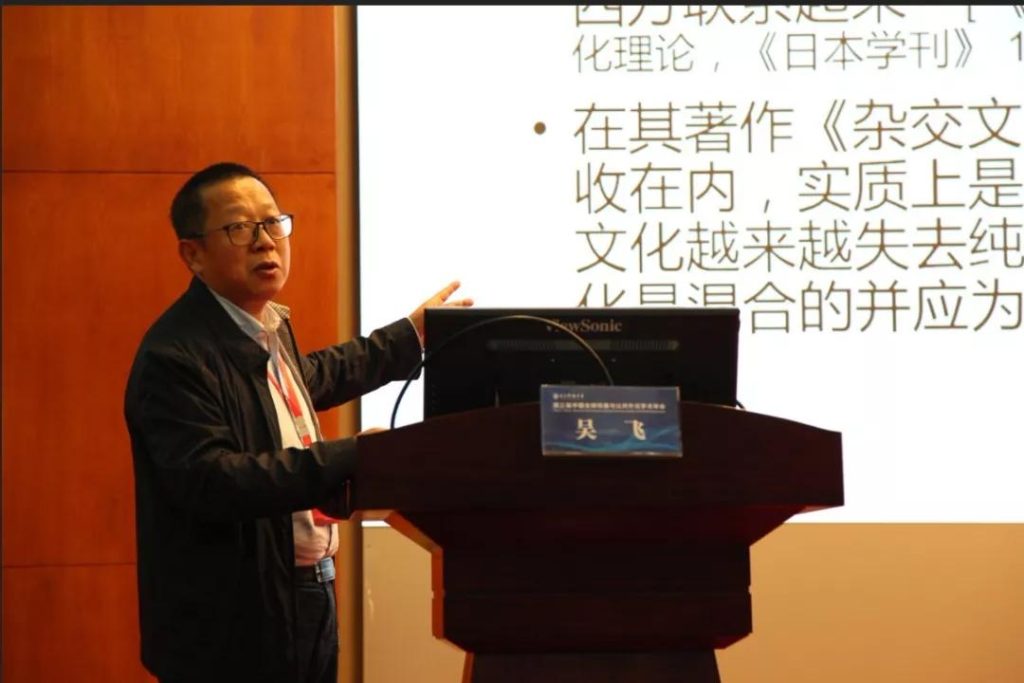
Guest Introduction: Wu Fei is a distinguished professor and doctoral supervisor at Zhejiang University. He enjoys the special allowance of the State Council, is a senior visiting scholar at the University of Wisconsin-Madison, and is the director of the Center for Public Diplomacy and Strategic Communication Research at Zhejiang University. He is also a member of the Postgraduate Education Steering Committee of the State Council Academic Degree Office, the chairman of the Global Communication and Public Diplomacy Research Committee of the Chinese Society of Journalism History, the vice chairman of the Communication Branch of the Chinese Culture Promotion Association, the dean of the School of Communication and Design of Zhejiang University Ningbo Institute of Technology, a special researcher at the National Internet Center, and an editorial board member of the International Journalism, China News Yearbook, and Journalism Practice magazines. He mainly studies communication and society, communication law, and journalism theory. His published works include Balance and Compromise: A Study of Western Communication Law and A Study of Journalism Professionalism.

Q: What do you think is the most significant communication feature in Japan’s rise?
A:Japan abandoned its policy of isolation and successfully learned and borrowed advanced science, technology and culture from the West, reformed its feudal social system, and embarked on the road of modernization ahead of other countries in Asia, Africa and Latin America, laying the foundation for Japan to become a world power.
Adhere to your own cultural characteristics. In the history of Japan’s development, it has continuously accepted a large number of foreign technologies and cultures. Each systematic introduction and creative absorption has had a profound impact on the development of Japanese culture. But each time they have adapted to local conditions and penetrated into the cultural traditions formed over many centuries. It can be said that these technologies and cultures have also been Japanized. For example, Japanese cultural companies have creatively mixed Japanese and foreign customs, images, spiritual issues and material products to produce popular comics, animations, TV shows, pop music and video games based on the interests and hobbies of young people around the world.
Q: What implications does Japan’s rise and its international strategic communication have for China’s global communication and public diplomacy?
A: In fact, the most important thing is to be able to open your mind and learn the best things in the world, whether it is science and technology or values, and to transform the closed-door and relatively closed regional thinking into global thinking . Since modern times, Japan has abandoned its closed-door policy and adapted to the rapidly changing world situation. It has successfully learned and borrowed advanced science and technology and culture from the West, reformed Japan’s feudal social system, and embarked on the road of modernization before other countries in Asia, Africa and Latin America, laying the foundation for Japan to become a world power.
Q. What is your opinion on current global communication research?
A: There are many aspects that are worth studying, and we can look at current research hotspots from three aspects.
We can start from the specific issues of conflicts and disputes among different international concepts, cultures and interests, and study the challenges and problems we actually face. For example, in the issues of Sino-US relations, Sino-Japanese relations, and the “Belt and Road Initiative”, studying these specific issues faced by the world in globalization has certain practical significance.
Abstract analysis and thinking at the theoretical level, multi-dimensional analysis of international affairs. Why are there so many conflicts and wars? If we abstractly explore and analyze the complex causes of these questions from a theoretical perspective, we may have new discoveries and conclusions.
Research on the abstract value concept level. For example, the traditional value concept of the Chinese is “Do not do to others what you do not want others to do to you”; the model of coexistence, Charles Taylor emphasized the “politics of mutual recognition”, and explore how to resolve or solve the root causes of conflicts between people and between countries from the background of multiculturalism.
Of course, at present our research perspective should focus more on the many difficult problems faced by China in its current development process. Facing these difficulties and exploring the causes and solving related problems is the most important research direction for our journalism and communication community today.

Q: What kind of cooperation do you think the Pan-Himalayan Communication Research Center and the Public Diplomacy and Strategic Communication Research Center of Zhejiang University can have in the future?
A: There will definitely. This annual meeting is an example of cooperation between centers, and we hope to continue to deepen the cooperative relationship in the future. Future cooperation will be carried out in three aspects: first, to maintain communication between teachers and students; second, to carry out cooperative research on both projects; and third, to strengthen learning exchanges between the two.