Guest Introduction: Second-level professor and doctoral supervisor at Tsinghua University; director of Tsinghua University International Communication Research Center, director of Tsinghua University Pakistan Culture and Communication Research Center, member of the Ministry of Foreign Affairs Public Diplomacy Advisory Committee, head of UNESCO Media Literacy and Dialogue of Civilizations Chair, advisory committee member of CITIC Foundation, and editor-in-chief of Global Media Journal. Professor Li Xiguang is the main founder of Tsinghua University School of Journalism and Communication and Tsinghua University Schwarzman College. He was the executive vice dean of Tsinghua University School of Journalism and Communication, a senior reporter of Xinhua News Agency, and a researcher at Harvard University Center for Journalism Politics and Public Policy.

It is very important to jointly build a cross-Himalayan civilization and economic circle
When talking about the importance of establishing a cross-Himalayan civilization and economic circle, Professor Li Xiguang believes that we first need to have a clear understanding of the Himalayas and the Pan-Himalayan region. In this regard, Professor Li Xiguang sorted out the geographical concepts of the Himalayas involving countries and the Pan-Himalayan region.
Professor Li Xiguang pointed out that we need to realize that the Himalayas are a diverse region, and its diversity has several aspects. One is regional diversity, which involves the vast land north and south of the Himalayas, from Xinjiang, Qinghai, Tibet, Yunnan, Gansu, to the northern mountainous areas of Pakistan, Ladakh, Kashmir, Sikkim, India, Nepal, Bhutan, as well as Myanmar and Bangladesh. So, geographically, it covers a very large range. Second, it is the diversity of religious culture, which involves Tibetan Buddhism, Islam, Hinduism, Han Buddhism, Theravada Buddhism and Shamanism.
Professor Li Xiguang believes that “the Chinese have always believed that the world and mankind are one big family, that the world is one community, and that people live in benevolence and righteousness. People should help each other.” Here, Professor Li Xiguang believes that as the people-to-people and economic exchanges among countries deepen, economic and cultural integration will be formed, promoting regional peace and development.
The great achievements of China’s Tibet reform and opening up have become a model for development in the Trans-Himalayan region
In this context, Professor Li Xiguang pointed out that we also need to consider how China can go global. Economically speaking, China’s economy is very strong in the world, and we need to boost various exports. The countries involved in the Himalayas are basically underdeveloped countries or undeveloped areas, which means that China’s potential market in the Trans-Himalayan region is very large.
Professor Li Xiguang said, “Contemporary China has its own political advantages and talent resource advantages in the Trans-Himalayan region. For example, in Trans- Himalayan communication, we can use the great achievements of China’s Tibet reform and opening up, economic construction, social progress, people’s lives, and education levels to influence everyone and let them see the beauty of Chinese modernity.” China can use its own minority professionals who are familiar with cross-border languages and cultures to play a special role in building the Belt and Road Trans-Himalayan Corridor.
Jointly build the “Belt and Road” and the Trans-Himalayan Community of Shared Future
Professor Li Xiguang also emphasized the importance of jointly building the “Belt and Road”. The China-Pakistan Economic Corridor has opened up the western section of the Himalayas. The Pan-Himalayan region must also promote common development through the construction of trans-Himalayan corridors, economic corridors, and cultural corridors. The professor said, “Nowadays, the earth’s resources are scarce and the population is expanding. We must put aside the binary worldview of Western monotheism, and mankind must integrate into the traditional Eastern atheism and polytheism. Through the construction of the Belt and Road corridor, everyone’s economy is complementary, and different cultural exchanges can develop towards a trans-Himalayan civilization community and a trans-Himalayan community of shared destiny, and finally achieve peace in this region, and most importantly, achieve common prosperity and common prosperity.”
The importance of building a community with a shared future for mankind
On May 19, in the theme report of “The Centripetal Force and Cultural Construction of the Community of Shared Future for Neighboring Countries”, Professor Li Xiguang also mentioned that the “Belt and Road” Initiative and the community of shared future for mankind are important programs and goals of contemporary diplomacy. We must explore the historical, geographical, ancestral, economic, religious and cultural connections between China and neighboring countries, restore the traffic of major mountain and river systems, establish a community of shared future for neighboring countries, and promote regional peaceful development.
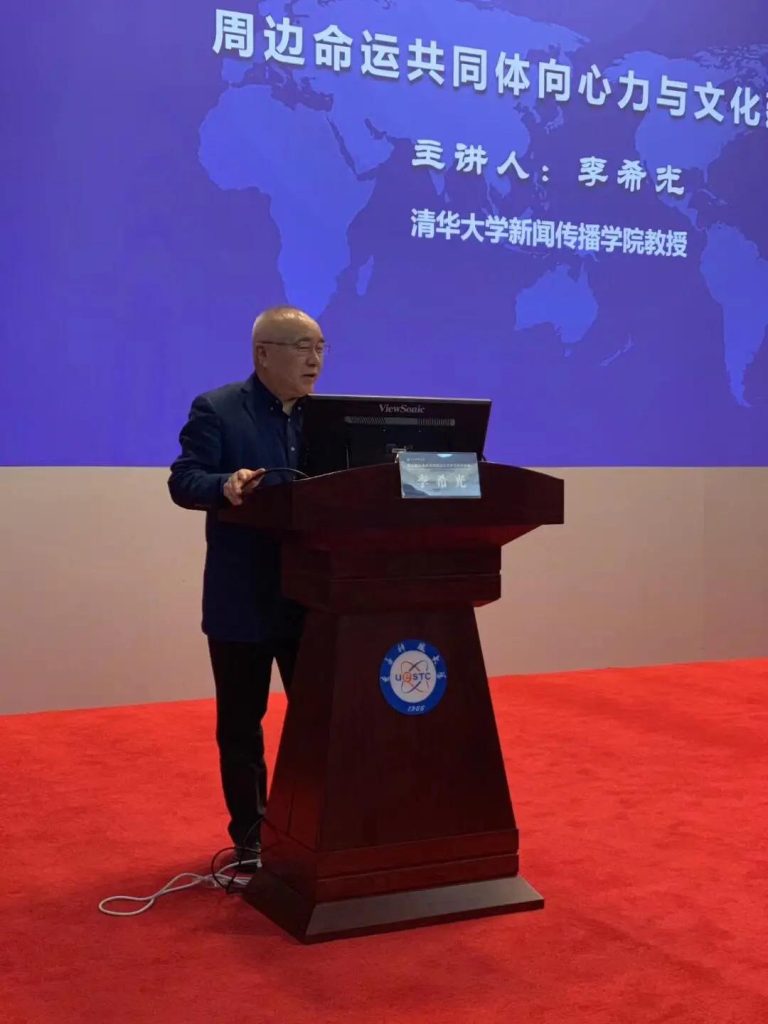
Professor Li Xiguang pointed out that building a bridge of communication among college
students along the Belt and Road will enable people to understand the value of the Belt
and Road. In the next 15 to 20 years, young people will become new leaders of the world,
and their values will be the new values of the Belt and Road and the community of a
shared future for mankind. Professor Li Xiguang said, “People-to-people communication is
also the social foundation for realizing a community of a shared future for neighboring
countries. Neighboring countries need to realize that we are all a community of symbiotic
connection, so that we can view each other’s differences with an attitude of tolerance and
mutual learning and promote cultural symbiosis.”