—–Prof. Kundan Aryal from Tribhuvan University
UESTC’s “Academic Exchange Month” series of courses aims to broaden students’ international horizons. On June 9, 2025, the School of Public Administration invited Professor Kundan Aryal, a well-known journalist and media research expert in Nepal and the head of the Department of Journalism and Mass Communication at Tribhuvan University, to give a special course on “Research on Media Change in Nepal”, which brought teachers and students an academic feast integrating media development, social change and cutting-edge thinking on global governance.
The speaker, Professor Kundan Aryal, is the head of the Department of Journalism and Mass Communication at Tribhuvan University in Nepal. He is also a freelance commentator/reporter for many media, the chairman of the Informal Sector Service Center (INSEC), a member of the Central Committee of the Madan Bhandari Foundation in Nepal, a member of the Management Committee of the Madan Bhandari Memorial College in Kathmandu, and the Secretary-General of the Tanka Prasad Acharya Foundation in Nepal. Professor Kundan Aryal has more than 30 years of experience in the media industry and journalism education. He is a well-known journalist and media research expert in Nepal and has a deep recognition and understanding of the joint construction of China’s “Belt and Road” initiative in Nepal.
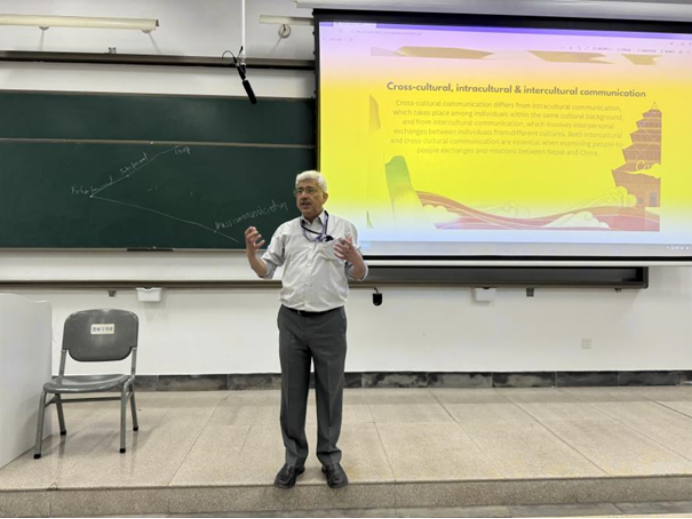
In the course, Professor Kundan Aryal briefly introduced his work background in the field of journalism and communication, and reviewed the evolution of Nepal’s media system and public opinion environment in recent decades. He pointed out that Nepal’s media has gradually moved from the stage dominated by traditional paper media to diversification and digitalization. The repeated changes in the country’s political system and the complex background of international geopolitics have had a profound impact on the direction of media development. The course revolves around the study of Nepal’s media changes under the “Belt and Road” initiative. Professor Aryal pointed out that since China proposed the “Belt and Road” initiative, Nepal, as an important hub country connecting South Asia and East Asia, has continuously improved its position in international communication and regional cooperation.
From the perspective of the intersection of cultural communication and global governance, he analyzed how the media can participate in the construction of the “Belt and Road” cooperation discourse system. In the course, Professor Kundan Aryal attached great importance to the interaction between teachers and students, and encouraged the students present to ask questions actively, which aroused enthusiastic responses from the participants. Students who participated in the lecture said that this lecture not only helped them understand the media ecology of a neighboring country, but also inspired a rethinking of the role of the media in global governance.
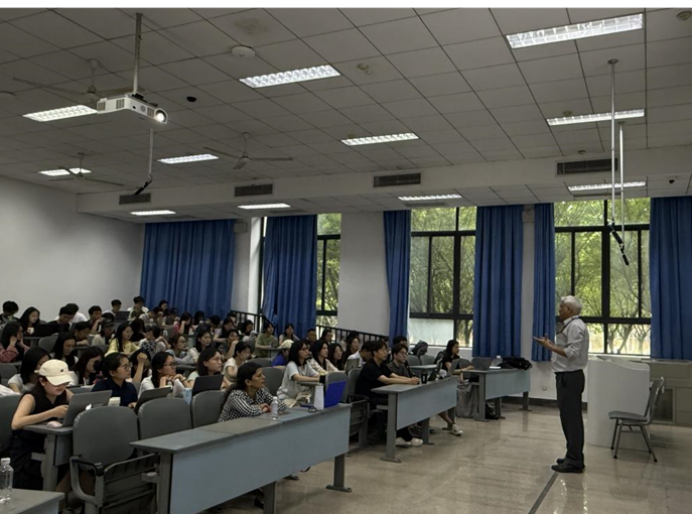
This course is one of the key projects of the “Academic Exchange Month” of the University of Electronic Science and Technology of China, which aims to enrich the curriculum system and expand students’ global vision and academic boundaries by introducing high-level international scholars. Professor Kundan Aryal’s visit and lectures not only built a platform for cooperation and exchanges between Chinese and Nepalese universities, but also provided a useful reference for exploring the development paths of Chinese and foreign media.